| |
 HARRY S. TRUMAN HARRY S. TRUMAN |
|
|
|
|
| |
Price: $9,500.00 |
Stock# 6827 |
| |
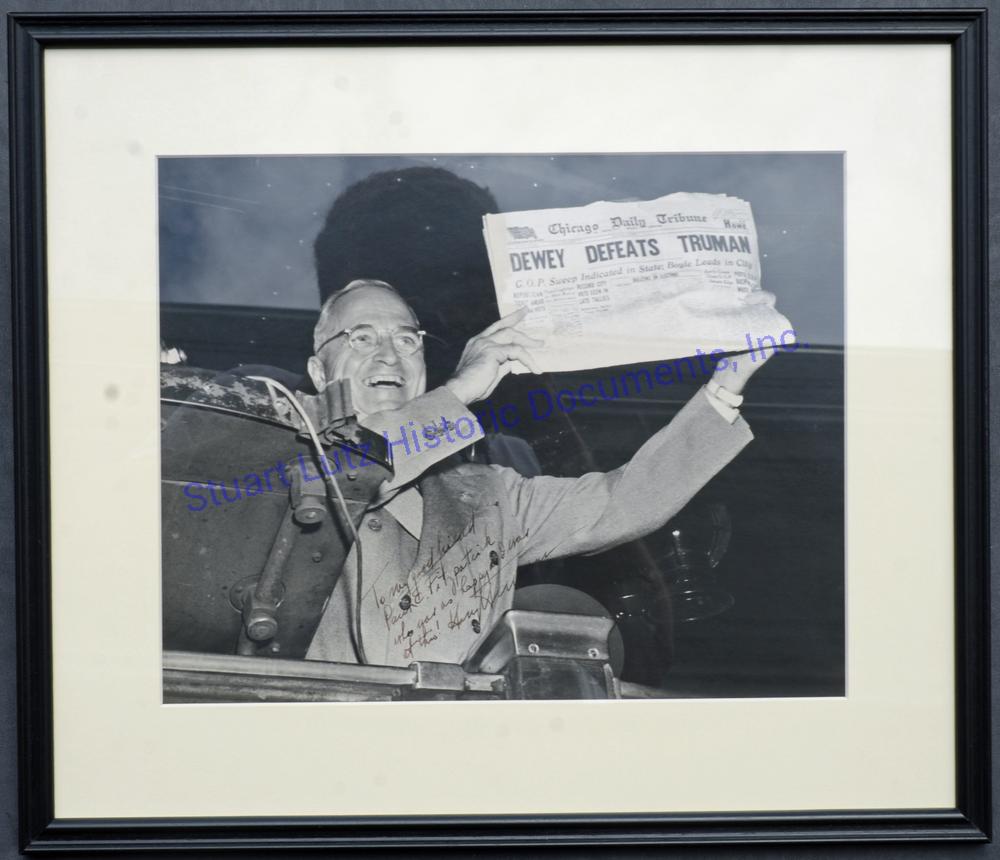
HARRY TRUMAN SIGNS THE ICONIC PHOTOGRAPH OF HIS PRESIDENTIAL UPSET
HARRY TRUMAN (1884-1972). Truman was the Thirty-Third President.
PS. No date [circa 1948]. No place [St. Louis, Missouri]. A black and white photograph signed “Harry S Truman” with an inscription “To my good friend Paul C. Fitzpatrick who was as happy as I was of this! Harry S Truman”. The photo shows a smiling Truman holding a newspaper with the headline “Dewey Defeats Truman”. Many media outlets believed Thomas E. Dewey was going to win the 1948 presidential election by a landslide, leading The Chicago Tribune to publish this paper before all votes were counted. As Truman said upon seeing the headline, “That ain’t the way I heard it!” This photo captures a victorious Truman with a message written to Fitzpatrick, the Chairman of the New York State Democratic Committee (Dewey’s home state). The photograph measures 13” x 10 ½”. It is in extremely fine condition and is professionally framed. One of the greatest Presidential collectibles of all time. |
6827
|
|
| |
| |
| JOHN TYLER |
|
|
|
|
| |
Price: $1,250.00 |
Stock# 4985 |
| |
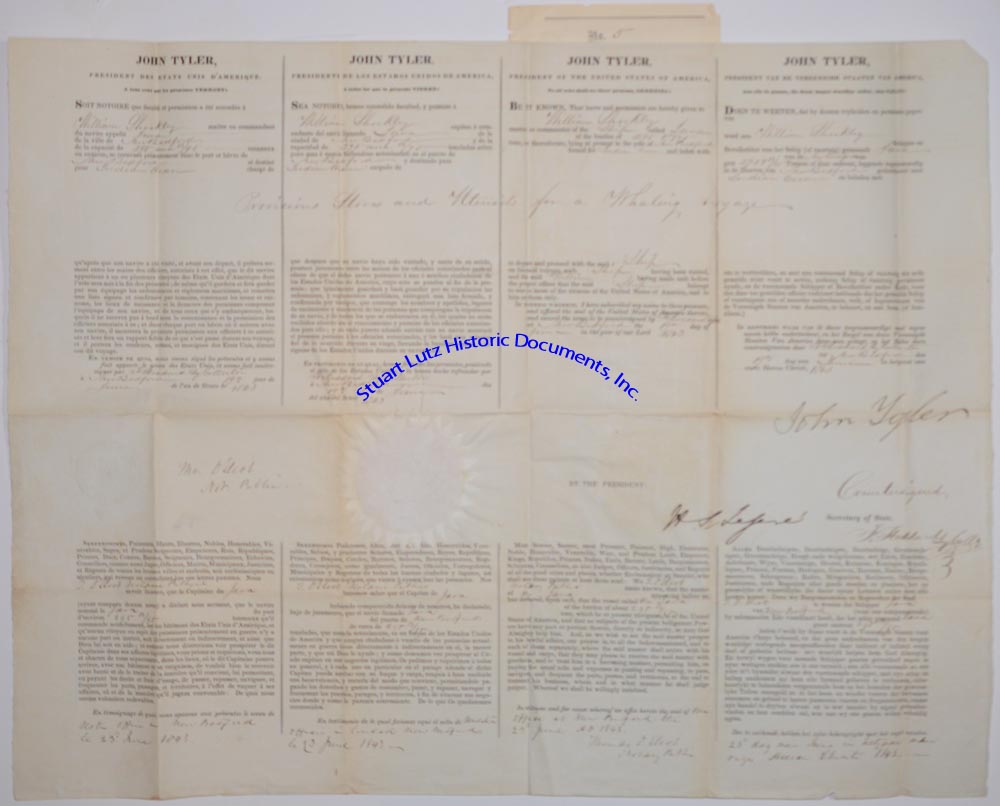
JOHN TYLER SIGNS A WHALING PAPER FOR A NEW BEDFORD SHIP
JOHN TYLER (1790-1862). Tyler was the Tenth President.
DS. 1pg. June 19, 1843. No place [Washington]. A partly printed, four language ships paper signed “John Tyler” as President and co-signed “H.S. Legare” as interim Secretary of State. The papers are for the Java, sailing from New Bedford, Massachusetts to the Indian Ocean. It was carrying “provisions stores and Utensils for a Whaling voyage”. The ship is listed in History of the American Whale Fishery, written by the appropriately named Alexander Starbuck, and the Java returned to New Bedford on April 3, 1845. The paper has the usual folds and a very large, dark signature that has a small pinhole because of fold intersections. |
4985
|
|
| |
| |
| JOHN TYLER |
|
|
|
|
| |
Price: $1,400.00 |
Stock# 6507 |
| |
JOHN TYLER SIGNS A WHALING PAPER FOR A NEW BEDFORD SHIP
JOHN TYLER (1790-1862). Tyler was the Tenth President.
ABEL UPSHUR (1790-1844). Upshur was appointed Secretary of the Navy by President Tyler; in July 1843, Tyler made him Secretary of State. On February 28, 1844, he was killed when the gun of the USS Princeton exploded.
DS. 1pg. September 27, 1845. No place [Washington]. A partly printed, four language ships paper signed “J Tyler” as President and co-signed “A.P. Upshur” as Secretary of State. The papers are for the William & Henry, captained by Ithamar B. Benjamin, and sailing from New Bedford. There was a whaling book about this ship, entitled Journal of the Mobile (Ship) and William and Henry (Ship), mastered by William Rawson and Ithamar B. Benjamin, on Whaling Voyages between 1836 and 1844. Although this paper was dated after Tyler’s term ended in March 1845, these papers were signed in masse by the President and distributed to the ports, and then used as needed. The paper has the usual folds (including a vertical one through the Presidential autograph) and a very large, dark signature. It is framed with an engraving of Tyler. |
6507

|
|
| |
| |
| JOHN TYLER |
|
|
|
|
| |
Price: $2,000.00 |
Stock# 6838 |
| |
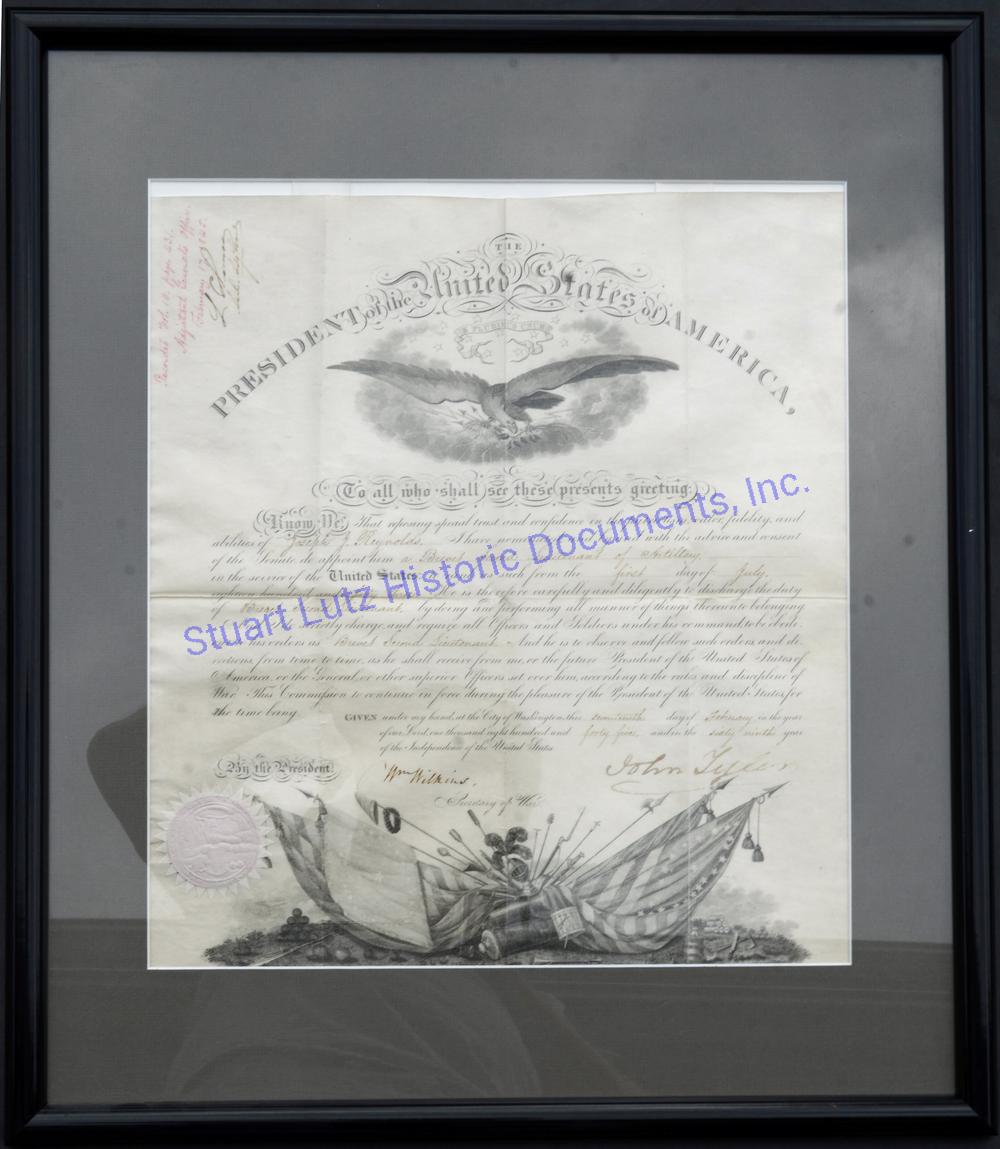
PRESIDENT TYLER SIGNS MILITARY COMMISSION FOR FUTURE UNION GENERAL JOSEPH J. REYNOLDS BEFORE HIS MILITARY SUCCESS
JOHN TYLER (1790-1862). John Tyler was the Tenth President.
JOSEPH J. REYNOLDS (1822-1899). Reynolds was an Union Civil War general who fought at Chickamauga.
DS. 1pg. 14” x 16”. February 17, 1845. Washington, D.C. A document signed “John Tyler” as President and “Wm Wilkins” as Secretary of War. Tyler appointing Joseph J. Reynolds to Brevet Second Lieutenant of Artillery. “Know Ye, That reposing special trust and confidence in the patriotism, valor, fidelity, and abilities of Joseph J. Reynolds, I have nominated, and by and with the advice and consent of the Senate, do appoint him a Brevet Second Lieutenant of Artillery in the service of the United States: to rank as such from the first day of July, eighteen hundred and forty three. He is therefore carefully and diligently to discharge the duty of Brevet Second Lieutenant, by doing and performing all manner of things thereunto belonging. And I do strictly charge and require all Officers and Soldiers under his command, to be obedient to his orders as Brevet Second Lieutenant. And he is to observe and follow such orders and directions, from time to time, as he shall receive from me, or the future President of the United States of America, or the General or other superior Officers set over him, according to the rules and discipline of War. This Commission to continue in force during the pleasure of the President of the United States for the time being. By the President: John Tyler Wm Wilkins Secretary of War”. In the mid-1800s, the Army had a very strict limit on the number of permanent officers allowed by Congress. When cadets graduated from West Point, there were not enough vacancies for them to become Second Lieutenants. Instead, they were commissioned as Brevet officers, allowing them to serve and gain experience while waiting for a permanent slot to open. This document shows the beginning of Joseph J. Reynold's military career; he would go on to become a Major General in the Union Army. He is best known for his role at the Battle of Cheat Mountain in 1861, where his forces pushed back Robert E. Lee’s first major offensive of the war. The Tyler signature is large and dark and the vellum has sharp folds; the condition is very good. It is professionally framed. |
6838
|
|
| |
| |
| (GEORGE WASHINGTON) |
|
|
|
|
| |
Price: $1,000.00 |
Stock# 4842 |
| |
(GEORGE WASHINGTON). (1732-1799). Washington was Commander-in-Chief of the Continental Army, President of the Constitutional Convention and the first President.
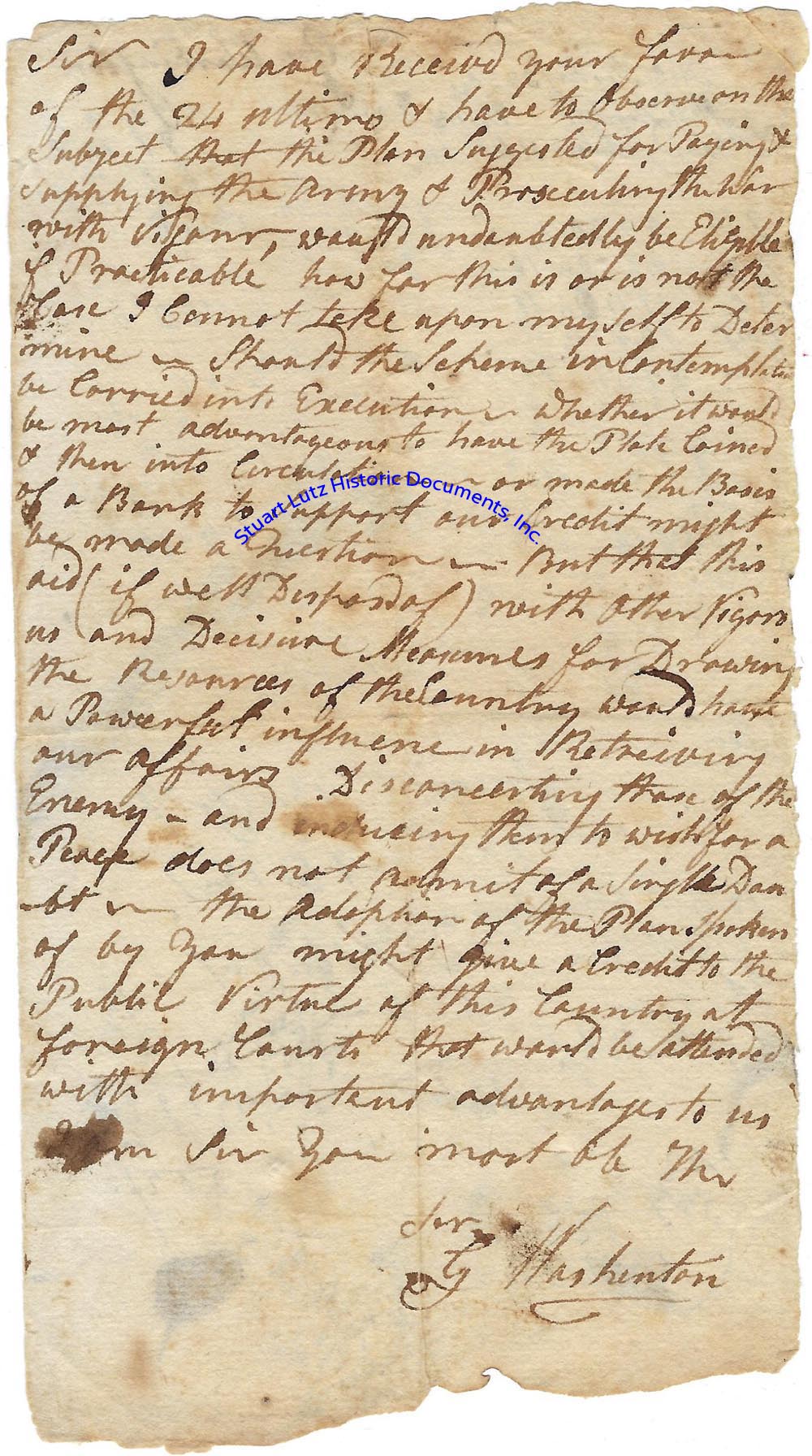
Contemporary copy. 1pg. November 7, 1780. Passaic Falls. A contemporary copy of a George Washington letter to Colonel Henry Babcock: “Sir, I have received your favor of the 24th of October, and have to observe on the Subject, that the plan suggested, for paying and supplying the Army and prosecuting the War with vigor, would undoubtedly be eligible, if practicable; how far this is, or is not the case, I cannot take upon myself to determine. Should the scheme in contemplation be carried into execution; whether it would be most advantageous to have the Plate coined and thrown into circulation, or made the basis of a Bank to support our Credit, might be made a question. But that this aid (if well disposed of) with other vigorous and decisive measures for drawing out the resources of the Country, would have a powerful influence, in retrieving our affairs, disconcerting those of the Enemy, and inducing them to wish for a peace: does not admit of a single doubt. The adoption of the plan spoken of by you might give a credit to the public virtue of this Country at Foreign Courts that would be attended with important advantages to us.” Colonel Henry Babcock (1736-1800), a Yale graduate, fought at Fort Ticonderoga in 1775. The next year, he was dismissed from command of Rhode Island troops because of his “distempered mind”. There is a vertical fold and contemporary writing on the verso. |
4842
|
|
| |
| |
| WOODROW WILSON |
|
|
|
|
| |
Price: $350.00 |
Stock# 6234 |
| |
TYPED LETTER SIGNED BY WOODROW WILSON DURING HIS PRESIDENCY OF PRINCETON UNIVERSITY ON THE IMPORTANCE OF THE MERCHANT MARINES: “THEY HAVE INTERESTED ME VERY MUCH AND INSTRUCTED ME NOT A LITTLE”
WOODROW WILSON (1856-1924). Wilson served as President from 1913 to 1921.
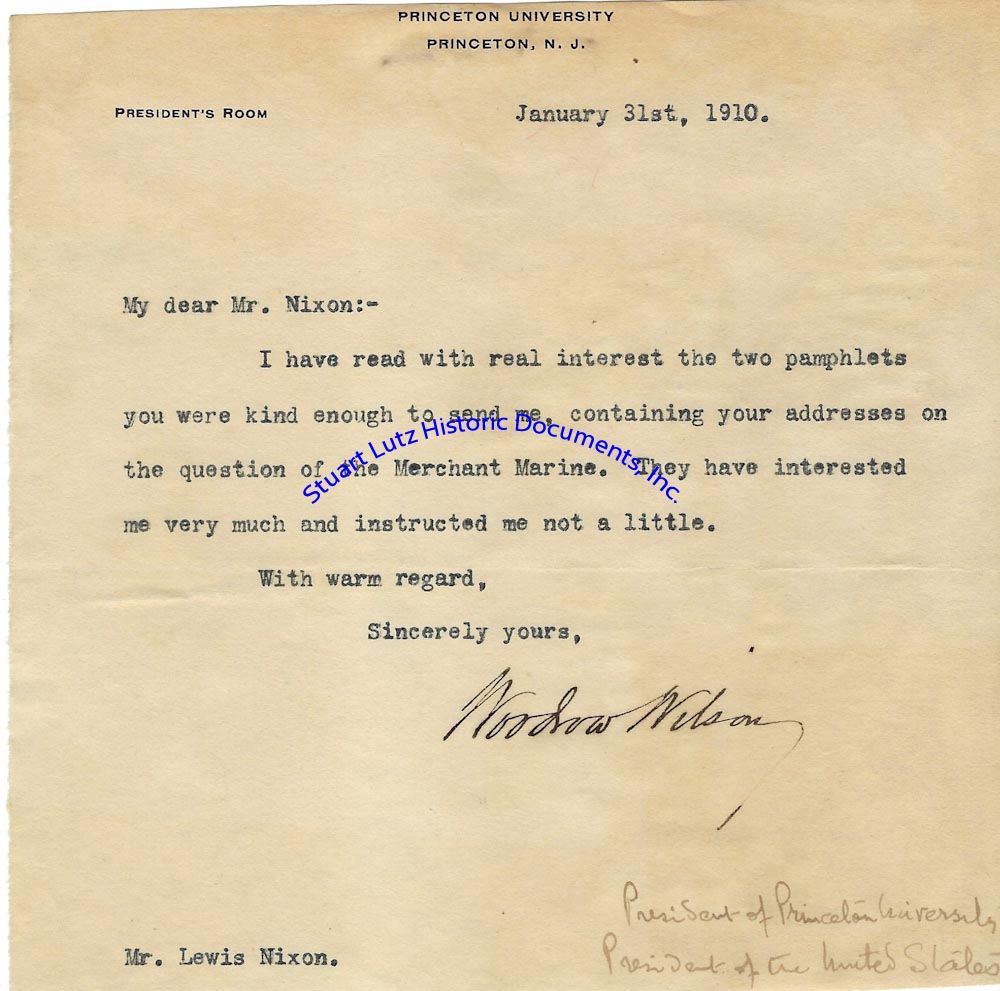
TLS. 1 pg. 8” x 10”. January 31, 1910. Princeton, N.J. A typed letter signed “Woodrow Wilson” as President of Princeton University to “Mr. Lewis Nixon”: “I have read with real interest the two pamphlets you were kind enough to send me, containing your address on the question of the Merchant Marine. They have interested me very much and instructed me not a little”. In 1910, Wilson was nominated and elected to be Governor New Jersey, and within three years he was elected President of the United States. As President during World War I, Wilson would advocate for an expansion of the United States Merchant Marine in his 1914 State of the Union address: “To speak plainly we have grossly erred in the way in which we have stunted and hindered the development of our merchant marine … It is necessary for many weighty reasons of national efficiency and development that we should have a great merchant marine.” This is an idea he perhaps received from Lewis Nixon (1861-1940), a well-respected naval architect, building executive, and Democratic political activist who frequently spoke on the importance of America increasing its naval power. America’s entry into World War I was in large part over Germany’s policy of unrestricted submarine warfare against American merchant ships. Wilson also signed the 1915 Seamen’s Act, “the Magna Carta of American sailors' rights.” In someone else’s hand, probably a previous owner, is the handwritten note, “President of Princeton University President of the United States”. The letter is on the official stationery of the “PRESIDENT’S ROOM” at Princeton. It is in very condition with trimmed margins, toning and a dark autograph. |
6234
|
|
| |
| |
<Previous 6> <Next 6>
|
 |